More crypto coins to watch and saving money on Ethereum gas

Privacy coins. I have always been into coins that protect privacy online. With bitcoin (and most other coins), since the blockchain is public, it is relatively easy to figure out who’s got what. And if you send someone coins, they can look up your address and see how much more you have. If you wrote someone a check, would you want them to be able to look up how much you have in your account? I think not!

Zcash ($ZEC) is a prominent example and the zk-SNARKs used for privacy are quite clever, but privacy isn’t required by default, and a lot of their transactions aren’t kept private (well over 90% to the best of my understanding). In my opinion, Monero ($XMR) is much better. Monero uses ring signatures to scramble lots of transactions together, making it virtually impossible to figure out who is sending how much where. I’ve heard it explained as “you’ll never be able to figure out who farted in an elevator full of 30 people.”

XMR seems somewhat undervalued, as it was well over $350 back in 2017, but has only slowly crept back up to $225 or so after trading for years under $100. It is a good mining coin. They used to constantly try to avoid ASICs and stay a GPU coin by changing their algo every 6-12 months, but haven’t had too much trouble since switching to the CPU-favoring algorithm RandomX.

There are several minor players based on XMR’s protocol, like Wownero ($WOW), a funny privacy-focused meme project similar to Dogecoin in its branding. This is a smaller cap coin and is something of a test net for Monero. There are a few others like Bitcoin Private out there and PirateChain ($ARRR), but I’m not so informed about them.

Cardano ($ADA) — the new Coinbase Pro listing. This project has been on the books for years and has a substantial market cap, but really hasn’t done a whole lot. I’m not particularly enthusiastic about it, but Coinbase Pro listings generally pump a bit in price and are often work buying elsewhere before Coinbase Pro starts trading (3/18 in this case).

Hydra — Don’t know a ton about it, but KuCoin is offering insane ~180% annual interest yields on this coin through their flexible “soft staking” “Pool-X.” 10 are required at a minimum (~$180 worth) but this is quite the interest rate!

Saving gas — Gas prices these days are no joke, often costing you $30 or even more for relatively simple transactions on the Ethereum blockchain. While long-term solutions are currently being discussed, these fees are killer right now! If you want to save on your Eth gas fees, check out GasNow.org to see what times of the day throughout the week have the lowest average prices.

New Crypto Updates

Coming soon to Coinbase Pro!
  • Coinbase Pro is adding support for Sushi, MATIC, and SKL. They will go live for trading in a few days, once enough people deposit these coins on the exchange for them to have enough on-hand for trading (liquidity). These coins could pump significantly after trading opens, so buying them elsewhere beforehand could be a good move. However, all three are near all-time highs. Sushi was kind of a scam but has started to recover its reputation (it’s a token for SushiSwap, a decentralized DeFi exchange). The other two are ERC-20 tokens. Sushi can be bought on KuCoin, and the others on Uniswap, though MATIC is on Binance.US.
  • Ethereum has committed to EIP-1559 in July. This is a protocol change (hard fork). They are going to stop paying miners high gas fees, and instead start burning them to help deflate the currency. They will allow for miner “tips” to be added to transactions when submitted. This may not reduce fees, and could leave many miners seeking greener pastures, which could reduce security and make the network more vulnerable to 51% attack. Or, it may succeed. Who knows?
  • B20 is continuing to blow up and has nearly doubled since I first wrote about it. It’s a tokenized NFT exhibit (like an art museum).

Cryptocurrency: Making money with Bitcoin, Ethereum, NFTs, DeFi, and more

Warning: don’t risk money you can’t afford to lose. What I write here is for your information and not financial advice.

Unbelievable gains (5x in a few months) have triggered significant interest in cryptocurrency. Meanwhile, rapid money printing (~35% of US dollars were printed in the last year) has raised fears about inflation, while high stock prices despite low earnings for many companies has fueled concerns about traditional investment. Cryptocurrency offers easier storage, movement, and liquidity compared to gold or other investments. Thus, more people than ever are looking to cryptocurrency to invest/store wealth and potentially for sending payments.

Many folks wonder where to begin. Here’s your guide from an interested layperson. (Disclosure: these are referral links that typically pay both of us a bonus if you use them to sign up).

What coins are out there?

  • Stablecoins. (USDC, USDT, Dai). These are pegged to the value of the dollar. They are convenient for moving money around and can earn you very high interest payments (from 2 to upwards of 70%), but their value isn’t going up unless the dollar does.
  • Bitcoin (BTC, XBT). The grandfather of all coins. Considered a major store of wealth, easily traded for almost any other coin, and easy to move around. The rest are “Altcoins.”
  • Ethereum (ETH). A full-featured coin that can run contracts. Currently supports most of the exciting projects in the space, like decentralized finance (DeFi) and non-fungible tokens (NFTs). However, transaction costs (“gas fees”) have risen significantly, often running $30-$60 per transaction, and they may lose out to other coins like BSC or DOT in the future depending on how things play out. Many “tokens” run on ETH, including some big ones like USDC and UNI.
  • Litecoin (LTC). Classic, “lightweight” coin for quickly and cheaply moving funds around and testing features for BTC.
  • Privacy-focused coins like Monero (XMR), ZCash (ZEC), Dash (DASH), and some lesser-known entrants like BEAM and Verge (XVG). These solve some issues with the other major coins.
  • Centralized projects. These are often frowned upon by the cryptocurrency community, since they are controlled by a small set of people and have single points of failure. Stellar (XLM), Binance (BNB), and Ripple (XRP) are big examples.

What’s the move?

  1. Buy cryptocurrency on an exchange.
    • Coinbase is one of the biggest, most well-known, easiest to use, and most secure. They offer some free coins (over $100 worth) if you watch short educational videos, answer quiz questions, and/or refer friends. Coinbase fees are really high at 2-3% or so per transaction, and they also seem to mark up the prices of cryptocurrency when you’re buying. If you have a Coinbase account, however, you automatically have a Coinbase Pro account too, however. Coinbase Pro has some more advanced trading features and isn’t as easy to use for beginners. However, the fees are much lower (almost 10x lower).
    • Kraken is a well-respected stalwart with a few more altcoins and compettitve interest rates on coins you stake.
    • Gemini is a secure, well-regulated exchange run by the Winklevoss twins.
    • KuCoin is a large, full-featured Singapore-based exchange with tons of coins and opportunities to earn interest by lending and staking (USDT offers a remarkable 70% APY for lending, though typical coins are 3-15%).
    • Uniswap is one of the largest and oldest places to exchange brand new decentralized finance (DeFi) coins, and to earn fees on them by “yield farming.” They gained a lot of respect by “airdropping” 400 of their token (UNI) to their users, which was worth $1,200 at the time and nearly 10x that amount now. Though other platforms are trying to improve on them by reducing fees (look out for Loopring, SushiSwap, PancakeSwap, and the aggregator 1Inch), this is often the go-to for these hot coins. The easiest way to use it is to have a MetaMask Chrome extension wallet to hold your assets in.
    • Honorable mentions: TradeOgre (lots of smaller coins), OkCoin (earning on Stacks (STX)).

      Most of these are insolvent and will steal your coins at the first opportunity; not recommended.
  2. Get interest on your coins.
    • Some exchanges pay you most of the interest you would get for “staking” your coins. They do it for you to make it simple and lower the minimum amounts required.
      • Coinbase pays relatively low rates — 5% on Cosmos (ATOM), 6% on Algorand (ALGO), 4.63% on Tezos (XTZ), 2% on Dai, and 0.15% on USDC. Coinbase Pro doesn’t pay interest. If you buy coins on Coinbase Pro to save on fees, transfer them to Coinbase (free/instant withdrawal, works seamlessly) to get the interest.
      • Kraken has better rates and supports more coins — 7% on Cosmos (ATOM), 5.5% on Tezos (XTZ), a nice 12% on Polkadot (DOT) and on Kusama (KSM), 9% on Kava and on Flow, and 5-12% on ETH (which can be locked up for ETH 2.0).
      • KuCoin has even more assets and good rates in flexible “Soft Staking.” Extremely high interest rates on USDT (70% or more).
  3. Keep your coins safe.
    • Set up security features like 2-factor authentication on all exchanges.
    • Minimize the amount of coins you store on exchanges.
    • The safest setups are official wallets on computers with little or no connection to the internet, or paper wallets (long term; make a few copies and store in multiple locations in case of loss).
    • Watch out for scams like sketchy paper wallet generators and unofficial software. If you download any software, it’s good practice and not too difficult to verify checksums (like SHA-256 or MD5) if the website provides them, which makes sure that no one has tampered with the files.
    • Watch out for the oldest scam in the book — anyone offering to take some crypto from you and send you more in return is not going to send you anything!
    • Be careful what websites you go to. Check the address to make sure you are on the right exchange and that it’s secure. People sometimes set up websites with common mispellings or send out sketchy links.
    • Never share your private keys or seed phrases for wallets with anyone. It’s best not to store them on anything that connects to the internet — write them down carefully, or store on unconnected devices.
    • Hardware wallets are good, but there are some glitches and plenty of stories of people locking themselves out.
    • Software wallets can be okay. Full wallets often require you to download entire blockchains (several GB), but are a good way to support projects you like. “Light” wallets don’t. Certain wallets allow you to keep many types of coins in one place —ZelCore is my favorite choice in this area, and is very secure and easy to use.
    • Don’t keep your eggs in one basket!

What coins should I buy?

In my opinion, you should prioritize Bitcoin (majority of your assets), and keep lesser amounts in the major altcoins (ETH, LTC, UNI, pretty much anything on Coinbase) and coins that allow staking/earning interest (XTZ, DOT, ATOM). From there, throw some money into hot DeFi projects. A great strategy is to see if Coinbase is about to list something (it pops up on Coinbase Pro before they start trading, or they blog about it), then buy some up on Uniswap before they start. This was a great way to snag NU or GRT before they quickly pumped ~400% each. Other assets I have my eye on are STX and B20, but you may be somewhat late to the game on these.

How do I research coins? How do I learn what’s hot?

Check Coinbase to see what’s being listed (currently, Sushi, MATIC, and SKL) and see if you can buy it cheap elsewhere before it pumps). Look up coins ($ then the symbol, like $BTC) on Reddit, Google, or Twitter. Get basic stats and charts on CoinMarketCap or CoinGecko, and check out the coin’s website (taking a look at their White Paper is smart if you have the time). Look for smart Twitter accounts, not just some moron shilling the same coins. Think what you will of the name but @WallStPlayboys are right 90% of the time, and you can go from there.

Addendum: Can I “mine” to become a millionaire?

Probably not. Mining means you are using your computing power to support a network, which pays you a small amount of their coin as a reward. It uses a lot of electricity, but it can be a profitable way to earn a coin gradually if you have the right equipment and pick coins wisely. It’s easiest to get in if you already have a high-end gaming PC and cheap electricity. NiceHash is easy, but has security risks, so it may be best to mine ETH or other major coins on your own. Every now and then, miners can get into brand new coins before anyone else can get their hands on them, but lots of projects end up being scams or withering away.

If you want your computer to make money for you, you are often better off leaving it running videos from Swagbucks and Gain.gg; $0.25-$1 a day each (and the latter can cash out directly to crypto).

PCR troubleshooting: tips and tricks for how to get your tricky reaction to work

Ahh, PCR, Kary Mullis’s Nobel Prize-worthy, LSD-inspired copy machine for DNA. He dreamed it up while driving down the Pacific Coast Highway, and now it’s used for everything from detecting SARS-CoV-2 to crime scene investigations to sequencing dinosaur DNA. Here are some tips I’ve picked up over the years:

  • Set up a 50 µL reaction, then split it into two 25 µL reactions. Run one at Tm, the other at Tm – 5 ºC.
  • Fool around with different DMSO concentrations. I have lately taken to using sulfolane (1-3%), an alternative to DMSO that may work better. Occasionally, sulfolane-DMSO mixtures have helped.
  • Play around with primer designs. Use a G or C at the 3′ end when possible to anchor it down (the “GC clamp”). Use an online tool to check for pesky self-complementarity, and tweak the primers to keep the Tm values close together.
  • Even if you don’t have fancy hot-start reagents, you can still manually hot-start a few PCR reactions at a time by adding the polymerase once the samples are up to temperature for the initial 98 ºC denaturation step. This is easier if you are adding the polymerase as a 5 or 10 µL solution in 1x buffer. (Hot start prevents annealing to off-target sequences in the important initial round of amplification. It also can improve yields and prevent primer dimerization).
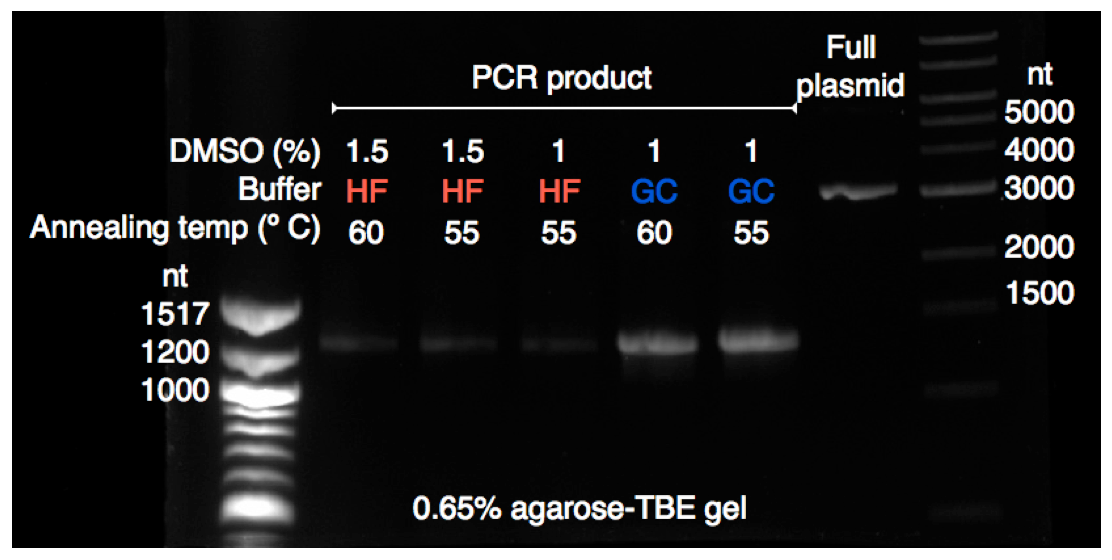
  • With the commonly-used Phusion high-fidelity polymerase, GC buffer works far better than HF buffer in my experience, despite the manufacturer’s recommendations to use HF first and GC only for difficult templates. Note that the error rate is twice as high for GC (9.5 x 10⁻⁷ versus 4.4 x 10⁻⁷ — a big relative change of 2.2-fold, but still small when the absolute rate is considered). The yield is much higher with GC buffer, and I sometimes don’t even get bands using HF.Screen Shot 2020-04-13 at 11.32.26 AM.png.

PittCoVacc: Pitt researchers create skin-patch COVID-19 coronavirus vaccine — but is it effective?

A team led by Drs. Louis Falo and Andrea Gambotto at the University of Pittsburgh have reported a COVID-19 vaccine that is delivered on small patches with 100 soft plastic needles. The vaccine was generated using a fragment of the spike protein that coronaviruses use to bind receptors to get into cells. After the mice received the vaccine, serum from them was diluted 100-fold, and incubated on a plate coated in the COVID-19 spike protein fragment. The serum successfully detected the protein when the mice had been immunized for ≥ 2 weeks (it detected the protein on an ELISA plate coated with it). However, the following questions remain unclear:

  • Are the antibodies generated using this vaccine actually capable of neutralizing the virus and preventing infection?
  • Will a similar vaccine produce a useful antibody response in humans?

The COVID-19 work in this paper was tacked on at the end. The primary focus of this paper was on MERS vaccines, however. You may recall that MERS is another very dangerous coronavirus (34.4% case fatality rate). It hasn’t spread particularly far outside the Middle East, save for a 2015 outbreak in South Korea, and only 2,513 confirmed cases have been reported. However, the MERS virus still remains endemic in Saudi Arabia. There are long-term MERS experiments reported in this work (including a 55-week experiment showing the durability of the response to the vaccine), suggesting that this research has been underway for quite some time. It is likely that the work was begun when back when the MERS threat loomed large, prompting significant interest and funding in the work. Unfortunately, we tend to lose interest and stop funding important work when it’s not plastered all over the headlines we read, so the MERS work likely lost steam until the COVID-19 “money experiment” was tacked on to the end of this manuscript. In other news, we are still waiting for a Zika virus vaccine/treatment (though it will take several years even with lots of interest/money thrown at the problem)…

The researchers should be commended for their great speed in delivering these promising early results. The sequence of the COVID-19 spike protein has not been known for very long, and they were able to clone the gene into a plasmid (with and without an “RS09” peptide adjuvant tacked on), express and purify the protein from mammalian cells, characterize the protein, fabricate the vaccine, test it in mice, and run the ELISA. This was all done with a “skeleton crew” remaining at the University of Pittsburgh, which is almost entirely shut down save for a few research projects deemed to be essential.

The vaccine is certainly on an interesting platform. Dr. Falo’s start-up company, SkinJect, has been developing these patches for quite some time. The patch-based vaccine supposedly doesn’t hurt that much compared to metal needles. It doesn’t need to be refrigerated, is easy to manufacture quickly at a large scale (a small academic laboratory can put together a few hundred in short order), works after you sterilize it with gamma irradiation, and is easy to apply anywhere (you can immunize yourself). Based on the MERS data, the SkinJect platform raises a better antibody response than traditional injected vaccines, likely the intradermal delivery with a bit of inflammation provoked by the needles primes the immune system to respond effectively. It remains unclear how the COVID-19 patch-based would compare to a traditional injectable.

Microneedle skinject.png

Ths was a impressive proof-of-concept rolled out in record time, but no one knows if the vaccine is actually effective, or if it will translate to humans. Still, these investigators are to be commended for their continued hard work and ingenuity at this difficult time.

Link to the paper (free of charge):
Kim, E. et al. “Microneedle array delivered recombinant coronavirus vaccines:
Immunogenicity and rapid translational development.” EBioMedicine (2020), https://doi.org/10.1016/j.ebiom.2020.102743.