Cryptocurrency: Making money with Bitcoin, Ethereum, NFTs, DeFi, and more

Warning: don’t risk money you can’t afford to lose. What I write here is for your information and not financial advice.

Unbelievable gains (5x in a few months) have triggered significant interest in cryptocurrency. Meanwhile, rapid money printing (~35% of US dollars were printed in the last year) has raised fears about inflation, while high stock prices despite low earnings for many companies has fueled concerns about traditional investment. Cryptocurrency offers easier storage, movement, and liquidity compared to gold or other investments. Thus, more people than ever are looking to cryptocurrency to invest/store wealth and potentially for sending payments.

Many folks wonder where to begin. Here’s your guide from an interested layperson. (Disclosure: these are referral links that typically pay both of us a bonus if you use them to sign up).

What coins are out there?

  • Stablecoins. (USDC, USDT, Dai). These are pegged to the value of the dollar. They are convenient for moving money around and can earn you very high interest payments (from 2 to upwards of 70%), but their value isn’t going up unless the dollar does.
  • Bitcoin (BTC, XBT). The grandfather of all coins. Considered a major store of wealth, easily traded for almost any other coin, and easy to move around. The rest are “Altcoins.”
  • Ethereum (ETH). A full-featured coin that can run contracts. Currently supports most of the exciting projects in the space, like decentralized finance (DeFi) and non-fungible tokens (NFTs). However, transaction costs (“gas fees”) have risen significantly, often running $30-$60 per transaction, and they may lose out to other coins like BSC or DOT in the future depending on how things play out. Many “tokens” run on ETH, including some big ones like USDC and UNI.
  • Litecoin (LTC). Classic, “lightweight” coin for quickly and cheaply moving funds around and testing features for BTC.
  • Privacy-focused coins like Monero (XMR), ZCash (ZEC), Dash (DASH), and some lesser-known entrants like BEAM and Verge (XVG). These solve some issues with the other major coins.
  • Centralized projects. These are often frowned upon by the cryptocurrency community, since they are controlled by a small set of people and have single points of failure. Stellar (XLM), Binance (BNB), and Ripple (XRP) are big examples.

What’s the move?

  1. Buy cryptocurrency on an exchange.
    • Coinbase is one of the biggest, most well-known, easiest to use, and most secure. They offer some free coins (over $100 worth) if you watch short educational videos, answer quiz questions, and/or refer friends. Coinbase fees are really high at 2-3% or so per transaction, and they also seem to mark up the prices of cryptocurrency when you’re buying. If you have a Coinbase account, however, you automatically have a Coinbase Pro account too, however. Coinbase Pro has some more advanced trading features and isn’t as easy to use for beginners. However, the fees are much lower (almost 10x lower).
    • Kraken is a well-respected stalwart with a few more altcoins and compettitve interest rates on coins you stake.
    • Gemini is a secure, well-regulated exchange run by the Winklevoss twins.
    • KuCoin is a large, full-featured Singapore-based exchange with tons of coins and opportunities to earn interest by lending and staking (USDT offers a remarkable 70% APY for lending, though typical coins are 3-15%).
    • Uniswap is one of the largest and oldest places to exchange brand new decentralized finance (DeFi) coins, and to earn fees on them by “yield farming.” They gained a lot of respect by “airdropping” 400 of their token (UNI) to their users, which was worth $1,200 at the time and nearly 10x that amount now. Though other platforms are trying to improve on them by reducing fees (look out for Loopring, SushiSwap, PancakeSwap, and the aggregator 1Inch), this is often the go-to for these hot coins. The easiest way to use it is to have a MetaMask Chrome extension wallet to hold your assets in.
    • Honorable mentions: TradeOgre (lots of smaller coins), OkCoin (earning on Stacks (STX)).

      Most of these are insolvent and will steal your coins at the first opportunity; not recommended.
  2. Get interest on your coins.
    • Some exchanges pay you most of the interest you would get for “staking” your coins. They do it for you to make it simple and lower the minimum amounts required.
      • Coinbase pays relatively low rates — 5% on Cosmos (ATOM), 6% on Algorand (ALGO), 4.63% on Tezos (XTZ), 2% on Dai, and 0.15% on USDC. Coinbase Pro doesn’t pay interest. If you buy coins on Coinbase Pro to save on fees, transfer them to Coinbase (free/instant withdrawal, works seamlessly) to get the interest.
      • Kraken has better rates and supports more coins — 7% on Cosmos (ATOM), 5.5% on Tezos (XTZ), a nice 12% on Polkadot (DOT) and on Kusama (KSM), 9% on Kava and on Flow, and 5-12% on ETH (which can be locked up for ETH 2.0).
      • KuCoin has even more assets and good rates in flexible “Soft Staking.” Extremely high interest rates on USDT (70% or more).
  3. Keep your coins safe.
    • Set up security features like 2-factor authentication on all exchanges.
    • Minimize the amount of coins you store on exchanges.
    • The safest setups are official wallets on computers with little or no connection to the internet, or paper wallets (long term; make a few copies and store in multiple locations in case of loss).
    • Watch out for scams like sketchy paper wallet generators and unofficial software. If you download any software, it’s good practice and not too difficult to verify checksums (like SHA-256 or MD5) if the website provides them, which makes sure that no one has tampered with the files.
    • Watch out for the oldest scam in the book — anyone offering to take some crypto from you and send you more in return is not going to send you anything!
    • Be careful what websites you go to. Check the address to make sure you are on the right exchange and that it’s secure. People sometimes set up websites with common mispellings or send out sketchy links.
    • Never share your private keys or seed phrases for wallets with anyone. It’s best not to store them on anything that connects to the internet — write them down carefully, or store on unconnected devices.
    • Hardware wallets are good, but there are some glitches and plenty of stories of people locking themselves out.
    • Software wallets can be okay. Full wallets often require you to download entire blockchains (several GB), but are a good way to support projects you like. “Light” wallets don’t. Certain wallets allow you to keep many types of coins in one place —ZelCore is my favorite choice in this area, and is very secure and easy to use.
    • Don’t keep your eggs in one basket!

What coins should I buy?

In my opinion, you should prioritize Bitcoin (majority of your assets), and keep lesser amounts in the major altcoins (ETH, LTC, UNI, pretty much anything on Coinbase) and coins that allow staking/earning interest (XTZ, DOT, ATOM). From there, throw some money into hot DeFi projects. A great strategy is to see if Coinbase is about to list something (it pops up on Coinbase Pro before they start trading, or they blog about it), then buy some up on Uniswap before they start. This was a great way to snag NU or GRT before they quickly pumped ~400% each. Other assets I have my eye on are STX and B20, but you may be somewhat late to the game on these.

How do I research coins? How do I learn what’s hot?

Check Coinbase to see what’s being listed (currently, Sushi, MATIC, and SKL) and see if you can buy it cheap elsewhere before it pumps). Look up coins ($ then the symbol, like $BTC) on Reddit, Google, or Twitter. Get basic stats and charts on CoinMarketCap or CoinGecko, and check out the coin’s website (taking a look at their White Paper is smart if you have the time). Look for smart Twitter accounts, not just some moron shilling the same coins. Think what you will of the name but @WallStPlayboys are right 90% of the time, and you can go from there.

Addendum: Can I “mine” to become a millionaire?

Probably not. Mining means you are using your computing power to support a network, which pays you a small amount of their coin as a reward. It uses a lot of electricity, but it can be a profitable way to earn a coin gradually if you have the right equipment and pick coins wisely. It’s easiest to get in if you already have a high-end gaming PC and cheap electricity. NiceHash is easy, but has security risks, so it may be best to mine ETH or other major coins on your own. Every now and then, miners can get into brand new coins before anyone else can get their hands on them, but lots of projects end up being scams or withering away.

If you want your computer to make money for you, you are often better off leaving it running videos from Swagbucks and Gain.gg; $0.25-$1 a day each (and the latter can cash out directly to crypto).
PCR troubleshooting: tips and tricks for how to get your tricky reaction to work

Ahh, PCR, Kary Mullis’s Nobel Prize-worthy, LSD-inspired copy machine for DNA. He dreamed it up while driving down the Pacific Coast Highway, and now it’s used for everything from detecting SARS-CoV-2 to crime scene investigations to sequencing dinosaur DNA. Here are some tips I’ve picked up over the years:

  • Set up a 50 µL reaction, then split it into two 25 µL reactions. Run one at Tm, the other at Tm – 5 ºC.
  • Fool around with different DMSO concentrations. I have lately taken to using sulfolane (1-3%), an alternative to DMSO that may work better. Occasionally, sulfolane-DMSO mixtures have helped.
  • Play around with primer designs. Use a G or C at the 3′ end when possible to anchor it down (the “GC clamp”). Use an online tool to check for pesky self-complementarity, and tweak the primers to keep the Tm values close together.
  • Even if you don’t have fancy hot-start reagents, you can still manually hot-start a few PCR reactions at a time by adding the polymerase once the samples are up to temperature for the initial 98 ºC denaturation step. This is easier if you are adding the polymerase as a 5 or 10 µL solution in 1x buffer. (Hot start prevents annealing to off-target sequences in the important initial round of amplification. It also can improve yields and prevent primer dimerization).
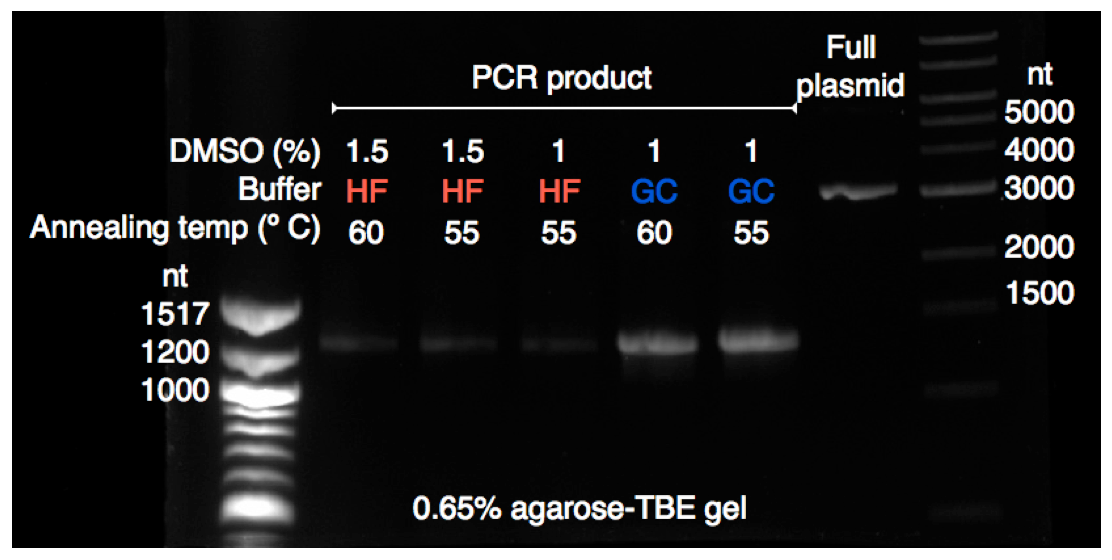
  • With the commonly-used Phusion high-fidelity polymerase, GC buffer works far better than HF buffer in my experience, despite the manufacturer’s recommendations to use HF first and GC only for difficult templates. Note that the error rate is twice as high for GC (9.5 x 10⁻⁷ versus 4.4 x 10⁻⁷ — a big relative change of 2.2-fold, but still small when the absolute rate is considered). The yield is much higher with GC buffer, and I sometimes don’t even get bands using HF.Screen Shot 2020-04-13 at 11.32.26 AM.png.

Lab tricks for organic chemistry researchers (chomatography edition)

  • A wide-bore needle is great for dipping TLC capillaries into airfree reactions. Try at 15 or 16 Ga. needle for commercial tubes (18 Ga. works if you order thin capillaries or pull your own, e.g., from Pasteur pipettes).
  • Handy flash chromatography tricks
    • This is based on a post from Phil Baran’s excellent blog. For small reactions (50–150 mg), 160 mm test tubes are convenient, disposable columns for flash chromatography. They are also highly useful for ion exchange chromatography, etc. Simply use a Bunsen burner and forceps to make a hole in the bottom, jam a cotton wad in, add a thin layer of sand, and pour in your silica gel/stationary phase (leaving plenty of room for mobile phase at the top). Apply pressure with a standard 14/20 gas adapter.
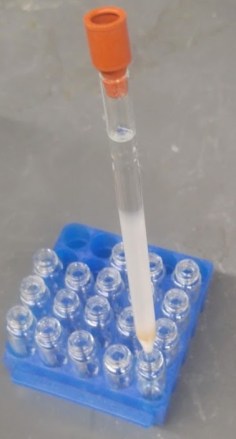
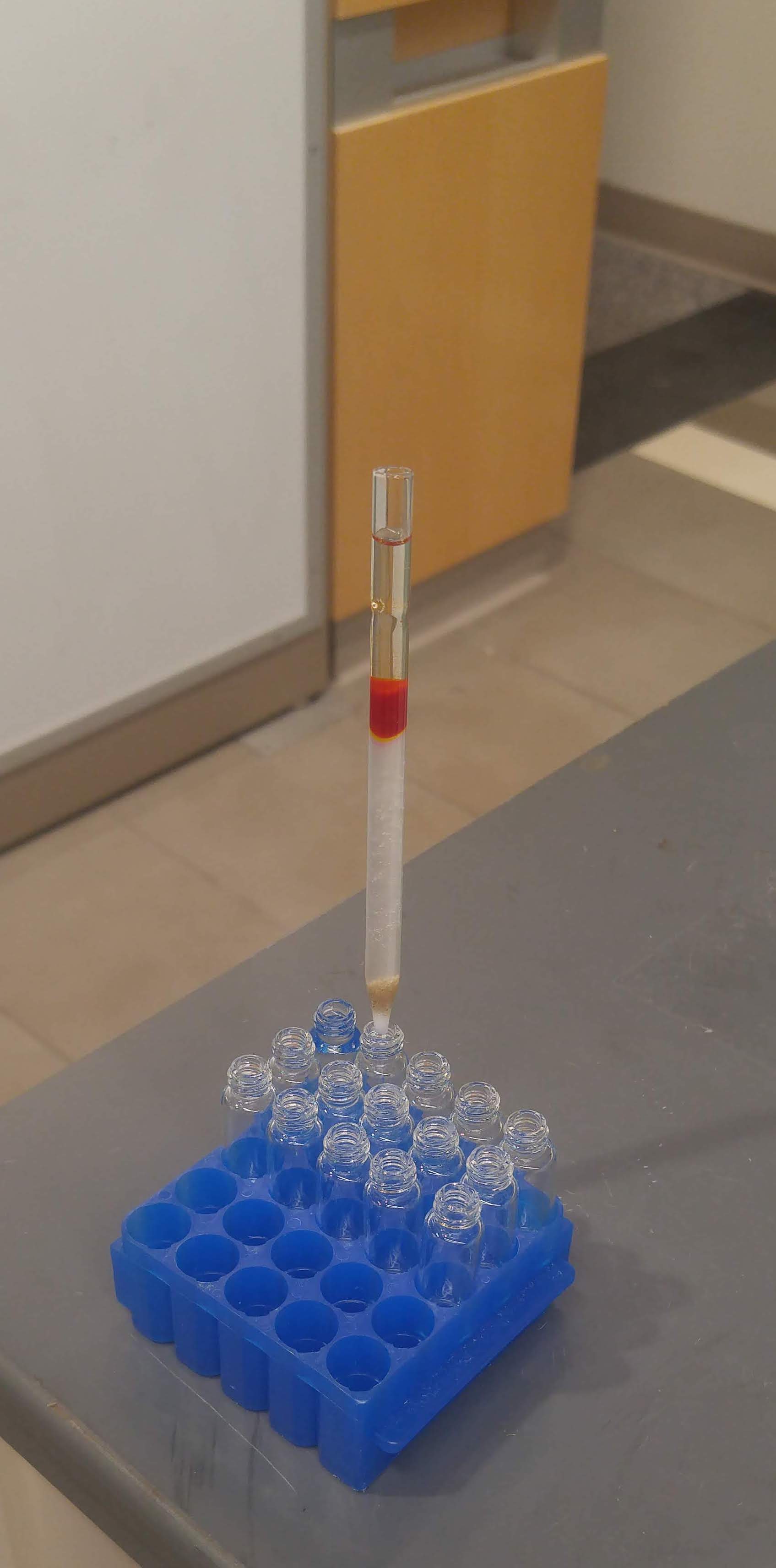
    • Pipette columns are highly convenient for purifying 10–40 mg of material, as noted by Alison Frontier’s excellent “Not Voodoo” page about it. I have a few practical tips to add for running these columns (see picture):
      • 1/2 dram glass vials are convenient for collecting fractions, and can easily be organized in a Simport Scientific “UniRack Jr.” rack (Fisher 22-038-542, Simport S50025Y). The pipette can be left standing in these vials and positive pressure applied as needed via Tygon tubing.
      • To “pause” the column, plug the top with a small septum (a 5 mm ID x 11 mm OD/ 8-9 mm OD tubing VWR sleeve stopper is shown here, VWR cat. no. 89097-534). After the stopper pushes out a few drops of mobile phase, flow will stop if you’ve sealed the headspace properly.
      • Set the Rf to 0.2, or set it to 0.3 and then either 1) cut the %EtOAc in half, or 2) switch EtOAc to Et2O (which has half of the eluting strength).
    • For purifying polar compounds, there is no reason to shy away from highly polar mobile phases. There’s a common myth going around that silica gel dissolves in mobile phases containing a high percentage of methanol. Newsflash(chromatography) — this has been disproved time and time again ([1] [2]).   I routinely use the following mobile phases and have never had a problem:
      • Amino acids with less polar side chains: 50:50 dichloromethane:methanol
      • Gangliosides: 60:35:8 chloroform:methanol:water
      • I have even filtered an aqueous solution of an amino acid over silica gel. For that, I did use a syringe filter to remove particles.
      • For TLC, there are no limits! 3:1:1 n-butanol:water:acetic acid, for example, is great for amino acids. It is quite viscous and runs slowly, however, and would be poorly suited for flash chromatography.
    • For sensitive compounds (e.g., electrophiles), consider using specialty deactivated silica gel (post forthcoming).
    • Reference: the original flash chromatography paper is only < 3 pg. and worth a read. Read for free at https://tinyurl.com/uzlcl6z.

Screen Shot 2020-03-24 at 7.03.30 PM.jpg

20200223_231848.jpg

PittCoVacc: Pitt researchers create skin-patch COVID-19 coronavirus vaccine — but is it effective?

A team led by Drs. Louis Falo and Andrea Gambotto at the University of Pittsburgh have reported a COVID-19 vaccine that is delivered on small patches with 100 soft plastic needles. The vaccine was generated using a fragment of the spike protein that coronaviruses use to bind receptors to get into cells. After the mice received the vaccine, serum from them was diluted 100-fold, and incubated on a plate coated in the COVID-19 spike protein fragment. The serum successfully detected the protein when the mice had been immunized for ≥ 2 weeks (it detected the protein on an ELISA plate coated with it). However, the following questions remain unclear:

  • Are the antibodies generated using this vaccine actually capable of neutralizing the virus and preventing infection?
  • Will a similar vaccine produce a useful antibody response in humans?

The COVID-19 work in this paper was tacked on at the end. The primary focus of this paper was on MERS vaccines, however. You may recall that MERS is another very dangerous coronavirus (34.4% case fatality rate). It hasn’t spread particularly far outside the Middle East, save for a 2015 outbreak in South Korea, and only 2,513 confirmed cases have been reported. However, the MERS virus still remains endemic in Saudi Arabia. There are long-term MERS experiments reported in this work (including a 55-week experiment showing the durability of the response to the vaccine), suggesting that this research has been underway for quite some time. It is likely that the work was begun when back when the MERS threat loomed large, prompting significant interest and funding in the work. Unfortunately, we tend to lose interest and stop funding important work when it’s not plastered all over the headlines we read, so the MERS work likely lost steam until the COVID-19 “money experiment” was tacked on to the end of this manuscript. In other news, we are still waiting for a Zika virus vaccine/treatment (though it will take several years even with lots of interest/money thrown at the problem)…

The researchers should be commended for their great speed in delivering these promising early results. The sequence of the COVID-19 spike protein has not been known for very long, and they were able to clone the gene into a plasmid (with and without an “RS09” peptide adjuvant tacked on), express and purify the protein from mammalian cells, characterize the protein, fabricate the vaccine, test it in mice, and run the ELISA. This was all done with a “skeleton crew” remaining at the University of Pittsburgh, which is almost entirely shut down save for a few research projects deemed to be essential.

The vaccine is certainly on an interesting platform. Dr. Falo’s start-up company, SkinJect, has been developing these patches for quite some time. The patch-based vaccine supposedly doesn’t hurt that much compared to metal needles. It doesn’t need to be refrigerated, is easy to manufacture quickly at a large scale (a small academic laboratory can put together a few hundred in short order), works after you sterilize it with gamma irradiation, and is easy to apply anywhere (you can immunize yourself). Based on the MERS data, the SkinJect platform raises a better antibody response than traditional injected vaccines, likely the intradermal delivery with a bit of inflammation provoked by the needles primes the immune system to respond effectively. It remains unclear how the COVID-19 patch-based would compare to a traditional injectable.

Microneedle skinject.png

Ths was a impressive proof-of-concept rolled out in record time, but no one knows if the vaccine is actually effective, or if it will translate to humans. Still, these investigators are to be commended for their continued hard work and ingenuity at this difficult time.

Link to the paper (free of charge):
Kim, E. et al. “Microneedle array delivered recombinant coronavirus vaccines:
Immunogenicity and rapid translational development.” EBioMedicine (2020), https://doi.org/10.1016/j.ebiom.2020.102743.

Reading list for med students (non-school books), part 2

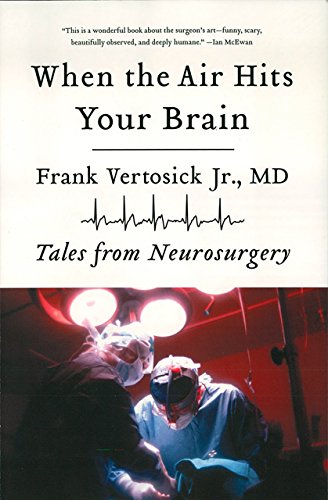
Adding to the list from before (Arrowsmith, Complications, When the Air Hits Your Brain), here are three great more titles to check out, just in time for winter break.

  1. Do No Harm: Stories of Life, Death, and Brain Surgery by Henry Marsh
    Marsh picks up where Frank Vertosick left off in When the Air Hits Your Brain‘s description of the painfully underfunded yet clinically astute practice in Merry Old England. Marsh is a somewhat curmudgeonly, seasoned surgeon who is deeply human despite his gruff-sounding narrator in the audiobook version. He recounts incredible stories of his work in England and in communist Eastern Europe. This is a very entertaining read! Complementary to Vertosik’s book, it is more thought-provoking about the medical system but less thought-provoking about brain surgery and humanity.
  2. House of God by Samuel Shem
    Although it recently came under some criticism in the New Yorker, this book is a classic chronicle of life as an intern with some unforgettable characters. This book chronicles intern year at a Boston hospital for a graduate of BMS (Best Medical School) and is an absolute must-read for interns. It features an unbelievable cast of characters and several immutable Laws of the House of God. Some of these laws are useful (Age + BUN = Lasix dose)*, others just funny (Show me a BMS (Best Medical Student, a student at The Best Medical School) who only triples my work and I will kiss his feet;
    If the radiology resident and the medical student both see a lesion on the chest x-ray, there can be no lesion there;
    The delivery of good medical care is to do as much nothing as possible.)
    All specialties should read this book.
  3. The Puzzle People: Memoirs of a Transplant Surgeon by Thomas Starzl. Dr. Starzl was a softspoken and incredibly hardworking surgeon who — nearly singlehandedly — invented the field of transplant surgery. He was hardworking to a fault (his secretary found him crawling to his desk to finish a manuscript when he was having a heart attack, and he sort of neglected his family), as you’ll see in the book. This book, however, gives you an incredible window into a great man’s life and career, and is highly recommended! We have come a long way since the first effective immunosuppressants were discovered. Starzl not only had incredible surgical technique that he perfected in groundbreaking surgeries, he also tirelessly worked to optimize immunosuppressant regiments in animal models and ultimately in the brave patients he took under his care.

*Med School Beast does not provide medical advice and is not responsible for the consequences of any medical decisionmaking you make. However, a good nephrologist I spoke to once said this formula actually works pretty well most of the time

The three best non-school books for medical students

Physicians have spilled plenty of ink over the years on matters academic and nonacademic. During (and before) the long slog of medical education, the following books provide telling insights into the practice of medicine and surgery, the psyche of patients and physicians, and – in a larger sense – what it means to be human.

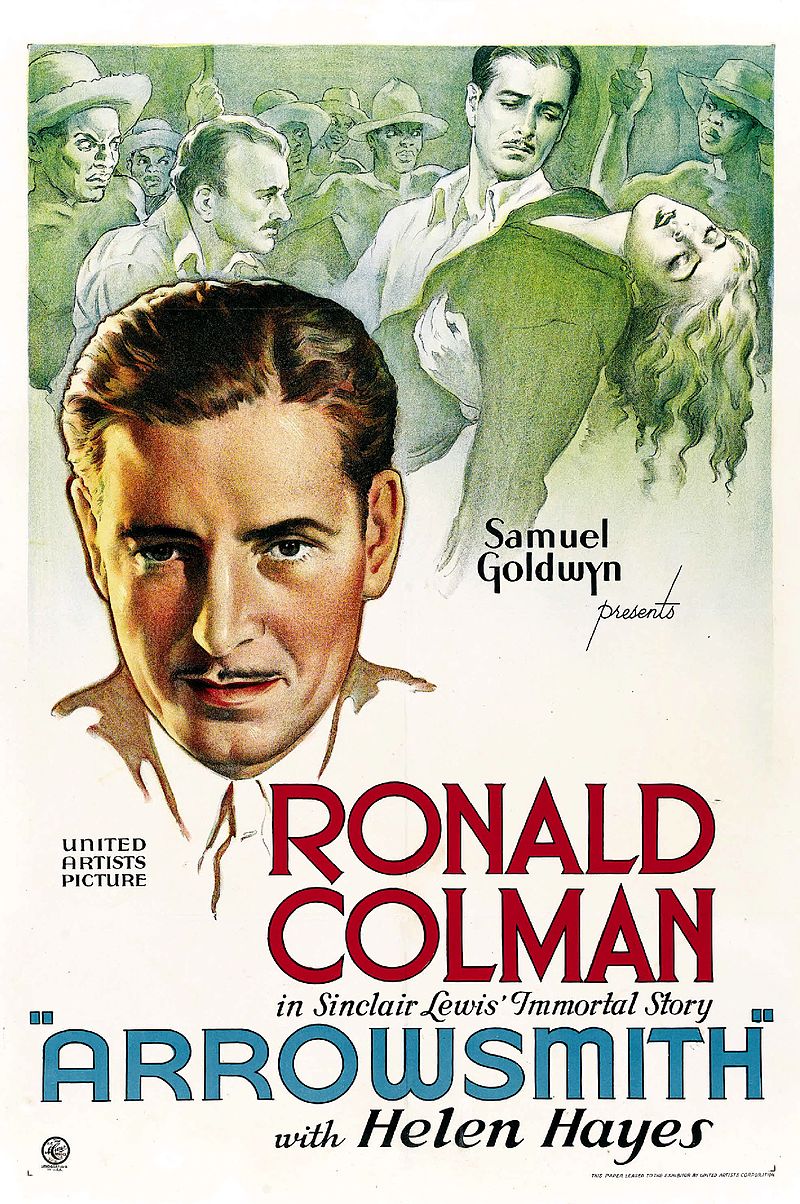
  1. Arrowsmith by Sinclair Lewis. Written by Nobel laureate Sinclair Lewis* in 1925, some of the science and the idioms are getting to be dated, but the timeless conflicts our protagonist Martin Arrowsmith faces are still relevant today.Arrowsmith follows the education and life of Martin Arrowsmith, an all-too-human Midwestern doctor as he grapples with medical school, his love life, and a career as a physician and scientist. Along the way, he grapples with local politics and with positions that force him to shove his passion for research to the back-burner and sell out for profits. In the end, he must grapple with being a good scientist and live up to his mentor’s admonitions, or trying to help as many people as he can. Arrowsmith’s personal flaws make him an eminently relatable protagonist, and Lewis’s writing effortlessly ties together scientific fact with expert storytelling. I stayed up until 4:00 AM finishing this book; once it picks up, I doubt you’ll be able to put it down. Despite its age, the conflicts Arrowsmith faces in his profession are perennially relevant, and you will think about this story long after you put down the book.It was adapted as a film in 1931, but the reviews say that this one’s a dud! It may be the moustache that does this one in.Arrowsmith_poster
    I’d like to once again give a shoutout to Ian Drummond’s excellent podcast, The Undifferentiated Medical Student (featured here on MedSchoolBeast), as Dr. Bryan Hambley mentioned this novel on the first episode, and I otherwise would not have heard about it.*With lots of help from microbiologist Paul de Kruif, who received 25% of the royalties but isn’t mentioned as an author!
    51HPLIENyVL._SX331_BO1,204,203,200_
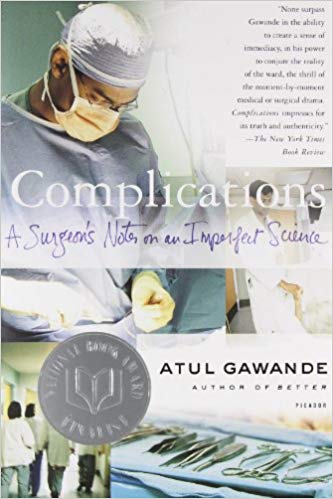
  2. Complications: A Surgeon’s Notes on an Imperfect Science by Atul Gawande. Gawande, a surgeon at the Brigham, has become famous for his excellent, simple writing (four books and pieces in The New Yorker). Though it’s his first book, Complications is the most engaging; he reflects on his most intense cases from residency in it. His later books, while good, lack the rawness of Gawande post-residency. Better: A Surgeon’s Notes on Performance gets an honorable mention. Being Mortal: Medicine and What Matters in the End is an illuminating and thought-provoking look at geriatrics. I have not read The Checklist Manifesto.
    51Xj8V3R2TL
  3. When the Air Hits Your Brain: Tales from Neurosurgery by Frank T. Vertosick, Jr., MD. This one came recommended to me by another MD/PhD student. Books by surgeons are a dime-a-dozen. Most feature hard-hitting, exciting stories about cases and seldom reflect on anything more profound. Vertosick, however, is a deep thinker. As he works through medical school and a grueling seven-year residency (with a detour to England in the middle), Vertosick considers the meaning of his work and what patients really want out of their surgeons. This one will stick with you.


How to use LabArchives as your Electronic Lab Notebook for Organic Synthesis Research

LabArchives—love it or hate it, a growing number of academic institutions are adopting it (reviewed here). As a “jack-of-all-trades” electronic lab notebook, it tries to cater to every field of science. If you do organic synthesis research, you may be disappointed at first as you struggle with the silly chemical sketcher widget, complete lack of integration with ChemDraw, and weak stock spreadsheet widget. Once you learn to use it, however, LabArchives isn’t half-bad. While it may not offer all of the chemistry-specific bells and whistles that come with Perkin-Elmer’s offerings or the slick ease-of-use that comes with (more biology-focused) Benchling, LabArchives is a serviceable option for synthetic chemists with the right tricks.

A good notebook entry for a reaction consists of three parts:

  1. Structure drawing,
  2. Table of reactants, and
  3. Experimental write-up and characterization data.

Here’s how to tackle all 3:

1. Structure drawing

  1. Just make it in ChemDraw!
  2. From there, copy and paste the structures and arrow into a Word document.
  3. Copy and paste from the Word document into a rich text entry in LabArchives.
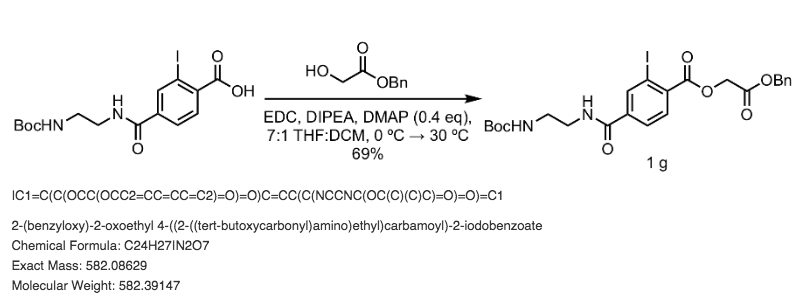
  4. In ChemDraw, select the product, and use the Structure → Convert Structure to Name command (⌥⌘N (Mac) or Ctrl + Alt + N (Windows)). Double-click it to resize.
  5. Then, use View → Show Analysis Window → Paste to add formula, molecular weight, and exact mass to the document.
  6. Copy the text box near the structure containing the IUPAC name, formula, MW, and exact mass, and paste into the LabArchives rich text entry.
  7. (Optional, but makes searching easier) Copy the structure as a SMILES string (Edit → Copy As → SMILES (⌥⌘C (Mac) or Ctrl + Alt + C (Windows)), and paste.

Screen Shot 2018-07-23 at 11.18.17 PM.png

2. Table of reactants

  1. Create a Google sheet.
  2. Starting in cell B7, make columns for the following:
    1. Compound
    2. Abbrev.
    3. Amount
    4. Unit (narrow column—just big enough to fit “mg” or “µL”)
    5. mmol
    6. MW (g/mol)
    7. d (g/mL)
    8. (Optional) CAS
    9. (Optional) Source
  3. Use formulas to make all of the calculations (e.g, for mmoles, just do =[amount]*[density]/[MW]). I like to calculate the theoretical amounts of all solids I’m supposed to weigh out, then go back and fill in the actual amounts as I weight them.
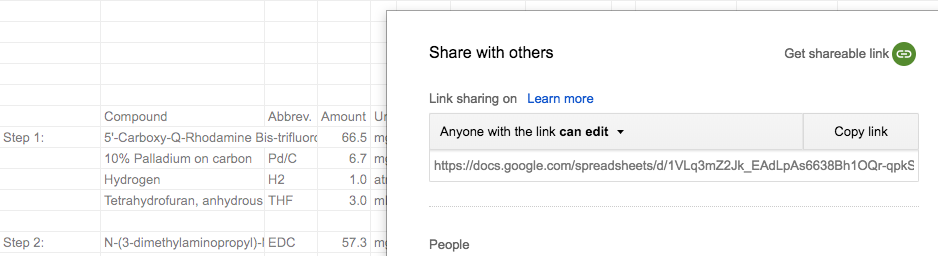
  4. Press “Share” in the upper right. Change the sharing settings to “Anyone with the link can edit,” then copy the link.Screen Shot 2018-07-23 at 11.27.12 PM.png
  5. In LabArchives, insert a Google Doc and paste the link. When you hit “save to page,” you’ll have a decent spreadsheet you can edit in your notebook.Screen Shot 2018-07-23 at 11.29.45 PM.png

Bam!

Screen Shot 2018-07-23 at 11.30.51 PM.png

3. Text and characterization data

  1. Write up an experimental.

    Acetic anhydride (150. µL, 1.59 mmol, 2.2 eq) was added to a solution of salicylic acid (100.3 mg, 726.2 µmol) in anhydrous pyridine (2.5 mL). The reaction mixture was stirred for 10 h at ambient temperature. It was diluted with 0.1 N HCl (20 mL) and extracted with EtOAc (3 x 15 mL). The pooled organic phase was dried (Na2SO4), filtered, and concentrated in vacuo, affording acetylsalicylic acid as a white solid in 87% yield (113.8 mg, 631.8 µmol).

  2. Upload all relevant data (I do PDFs exported from TopSpin for NMR). FolderMonitor could be good here (if you install it on the computer where you collect a lot of data and set it up to upload it automatically), but I find it’s easier to just upload to each individual page.
  3. For TLC plates, take a photograph of the plate with your phone. For UV-absorbing compounds, I like to cut a ~1″ square hole in the top of a shoebox-sized box, cut a ~3″ x 6″ “door” in the side to shine in a UV lamp, and then photograph the plate inside the box. My photos automatically upload to Google Photos. Then, I quickly crop the images in Google Photos, right-click and copy them, and paste them into my notebook entries (the rich text portion). I double-click them to resize them to something reasonable (e.g., 300 pixels in height).

Organization

I prefer to put each compound on its own page and number each page. Every now and then, I get characterization data for reagents, which I put into a “Reagents” folder.


Conclusion

LabArchives is a versatile platform for lab notebooks. It can be useful for synthetic organic chemistry if you make the proper tweaks and take advantage of other applications’ functionality (e.g., ChemDraw, Google Sheets, and Google Photos) to make it work.