Review: “How I got a 260” USMLE Step 1 Advice Podcast

Screen Shot 2018-07-28 at 1.18.17 AM.png

I recently came across a well-done episode of the excellent Surviving Medicine podcast entitled “USMLE Step 1 Advice – How I got a 260.” Frank Cusimano, the medical student and PhD candidate who hosts the show, deviates from his usual interview format to read a letter from a colleague who scored a 260. The letter, though quite dense, brings up a number of good points that are worth reiterating. Here’s a summary of some of the take-home messages (with my own advice sprinkled in, marked with MSB>), though I highly recommend checking out the podcast via the above link (or via iTunes/Google Play/other Android apps).

  • Other people may have come up with study plans that worked for them, but you need to tailor one that will work for you.
  • There is no substitute for quality time spent studying.
  • There is no substitute for learning the material correctly the first time! A recipe for failing Step 1 is trying to make up for not learning the material in the first place. Step 1 study resources are review resources. If you don’t learn the material properly during your MS1 and MS2 years, there’s nothing to review.
  • The difference between a 220 and a 260 is random facts from your courses that are not in First Aid. That’s why it’s important to learn the material in-depth the first time (see last point). Further, that’s why it’s important to relegate First Aid to its proper place. You may wind up with four detailed questions on urinary incontinence (as the letter-writer on the show did), MSB> or four on chronic granulomatous disease (as I did).
  • That said, First Aid is an essential reference, and it’s important that you know about every topic listed in it.
  • During MS2, familiarize yourself with your Step 1 resources during the courses. Get a feel for what material is important for the boards. Also, by learning your way around the books you’ll be using to review for Step 1, you’ll be able to hit the ground running. Don’t go overboard though. Relegate First Aid to a quick 30-minute perusal during each course. Pathoma can be used much more thoroughly during the organ block courses; MSB> I recommend at least going through all the videos. If you have extra time to listen to podcasts (after listening to your medical school coursework and then to Goljan), you can listen to Pathoma‘s audio files as well.
  • What you shouldn’t worry about:
    • How you score on UWorld questions (it doesn’t matter until ~7 days out).
    • Finishing UWorld. Quality use of UWorld (post forthcoming) is more important than sacrificing depth so you can finish all of the questions.
    • MSB> What your classmates are doing.
  • Apparently you must get ≥6 months of UWorld in order to have the option to reset the Q-bank (question bank). MSB> I personally never reset my Q-bank though.
  • UWorld is the most useful Q-bank, and I didn’t like Kaplan. MSB> Don’t buy any other Q-banks. You won’t have time to use them if you’re going through UWorld carefully and using a variety of books that most of your classmates will have overlooked to review (as I recommend). I also tried Kaplan and didn’t like it. None of the other Q-banks write questions anything like the test, nor are their figures and explanations as good as UWorld. They are not worth your time.
  • The NBME practice exams (with the score reports) are the most useful predictors of your score and provide crucial practice for test day. They don’t let you review all the questions though, MSB> but there’s a good method I used to help get around this (post forthcoming). Also, to predict your score, you can combine NBME tests with your UWorld data
  • Don’t take a practice test within the last 5 days.
  • Do lots of UWorld questions with mixed material the week of to keep yourself fresh and prime your brain to answer USMLE-style questions quickly.
  • Plan some half days and some full days off of studying to do something you enjoy (MSB> preferably something that won’t cause a massive hangover).

Put on your blinders to succeed on the USMLE Step 1

The rumors and details you will overhear about your classmates’ studying will shock you. They can stun even the most conscientious student with pangs of worry and feelings of inadequacy.

“Did you hear about Caroline?” they’ll say. “She already made 3 passes through First Aid and is already starting her 4th, and she also did UWorld twice.”

“Yup, I just finished my second pass through cardio, neuro, and renal. Since we have 7 weeks to go I figure I’ll finish Kaplan’s q-bank and do UWorld again, then see how I do on my 5th NBME practice test.”

The examples above are merely generalities about studying “achievements.” If you start talking about the details of—say—renal pathology, antiarrhythmics, or glycogen storage disorders, your buddies might be spouting off answers from memory while you wonder how you got so far behind (and how to spell “antiarrhythmics”).

Hearing these statements from seemingly superhuman classmates who are abusing First Aid can make you feel like your competition is running circles around you, and make you think you’re way behind. That’s why I found it best to “put my blinders on” while preparing for Step 1.

Often, the student who sound like they’ve studied extensively (the “multiple passes after only 3 weeks” folks) are overly focused on First Aid to the exclusion of better resources. They may have developed a destructive First Aid addiction early-on, forgoing their deeper course readings for First Aid‘s superficial outline. If they claim to have gone through UWorld multiple times, they may have sped through it without reviewing questions they got wrong and without reading the explanations carefully.

The advice you receive from this blog (assuming you have similar study habits so it will work for you) will guide you towards a better score. Further, in the long run, if you follow this advice, you will be better prepared for your clerkships with a deeper, more conceptual understanding of the material based on your readings of multiple sources (as compared to some of your “memorization junkie” classmates).

It’s absolutely essential that you have a study plan tailored for what works for you. The anonymous student who received a 260 and gives advice on the Surviving Medicine podcast ([pending] blog post: link; actual podcast: link) reiterates this point several times. Most students heed this advice and tailor a study plan. You classmates are following their own plans. Listening to their patter as they work through their plan is irrelevant. Until test day (and perhaps even on test day!), they will continue to have large gaps in their knowledge. Puffed-up classmates may not show these knowledge gaps as they spout off the material they’ve already conquered; it’s easy to mislead yourself into thinking they have no weaknesses. There’s no need to feel inadequate when they seem to have all the answers. I recommend avoiding the subject of boards prep with friends unless you really think you have some wisdom to gain from them (or you have something to get off your chest). Talk about anything else!

tl;dr—Have your own plan and ignore what your classmates are bragging about as you prep for Step 1.

Books, podcasts, and websites for ophthalmology clerkships

Despite its fearsome reputation among spelling bee contestants, ophthalmology is the crown jewel of medical specialties. Most ophthalmologists cite reasonable hours, good outcomes, generous compensation, quick and satisfying surgeries, and a good mix of clinical practice with operating as key aspects they love about their jobs. Indeed, ophthalmology has one of the lowest burnout rates of any field, and a shocking amount of ophthalmologists “pass on the speciality” to their children.

For many med students, ophthalmology is an unfamiliar, niche subject:

Whether you’re new to ophtho or you’ve already realized that it’s the greatest speciality, you’ll need some good resources on deck to help master the basics. Even if you don’t want to go into ophthalmology, mastering the basic eye exam will help you diagnose neurologic disease, deal with common ocular complaints, and assess the progression of diabetes. Far from being an isolated organ, the eye gives you the only means of viewing the CNS noninvasively, and the retinal vasculature closely parallels that of the kidneys.

  • Practicing the retina exam
    • If you can get access to an indirect and a condensing lens (20 D), the little eye cube that comes with Welch-Allyn direct ophthalmoscopes is a good model for practicing. Unlike (non-comatose) patients, models don’t care if you shine bright lights at them for an hour!
  • Suggested books
    • If new, start with OphthoBook (https://timroot.com/ophthobook/). You can read PDFs of each chapter for free online, but I prefer the print copy. I highly recommend reading it before starting any ophtho clerkship.
    • Start OphthoBook Questions towards the end of OphthoBook.
    • Helpful books I found in my library:
      • Slit Lamp: Examination and Photography B5 .M37 2007 (oversized). You can skim the historical and photographic discussions, but the beautiful images will help you start recognizing patterns. This book does a great job of breaking down how experienced ophthalmic healthcare workers control lighting with the slit lamp for viewing various ocular structures and pathology.
      • Practical Ophthalmology: A Manual for Beginning Residents RE75 .M36 2005 is good for starting to appreciate the techniques.
      • Wills Eye Manual is a good reference for tagging along with residents; you’ll find concise information for dealing with nearly anything that comes into the ER.
      • Ophthalmology Made Ridiculously Simple RE56 G56 1987 is worth a skim if you need to brush up on the basics. It’s concise and a decent example of an MRS book; you’ll find the other titles in this series useful for micro and for the boards.
      • Vitreoretinal Surgery RE501 .W55 2008 is a good way to get oriented if you are spending a morning in the OR with a vitreoretinal (VR) surgeon.
    • Basic Ophthalmology is good; an old edition is fine.

In the words of my attending, “Basic Ophthamology is too basic; Practical Ophthalmology would be practical.

  • Websites
  • Podcasts
    • Tim Root has two podcasts covering the basics (the eye exam and anatomy): https://timroot.com/extras/.
    • Dr. J. Lawton Smith recorded some really good neuro-ophtho lectures in the 1970’s. They’re really funny since he uses wacky South Carolina idioms (“happier than a dead hog in the sun,” “Marcus-Gunn pupil wide enough to drive a Mack truck through it,” “enough Mydriacyl to float the Queen Mary,” “MMM-mmmmm!” “rare as hen’s teeth,” “more hypermetropia than you can shake a stick at,” etc.). Find them at https://novel.utah.edu/Smith/outline.php They are a bit dated, however. The first ten or so are more boring, but then Dr. Smith starts drinking more coffee and using weirder idioms, so they get much more “high energy” and exciting. He has some really “knock-out” patient interviews on some of the tapes.
    • Straight from the Cutter’s Mouth: A Retina Podcast (http://www.retinapodcast.com/)—Lots of episodes; very hit-or-miss and way too much sports talk on some of them! I recommend the ones where they interview Dr. Matthew Weed about inherited retinopathies (Ep. 76, 62, 56, 23). The matched MS4 panels (Ep. 89 and 21) are also quite good.
    • Eyetube.net podcasts
      • New Retina Radio—Great content but the most annoying transitions possible. Definitely check out the anti-VEGF biographies!
      • Ophthalmology off the Grid—Excellent content! I wish it came out more often. Often focused on cataract surgery and innovations. Ep. 29, “From Engineering to Vitrectomy” is pretty inspiring; the interviewee is a machine and a standout in the field.

The 7 best books you’re missing for USMLE Step 1 prep

The USMLE Step 1 is no joke, so you’ll want to go in having studied from the best resources. No one resource contains everything you need to know (yes, this includes First Aid); consequently, I recommend having a wealth of resources and drawing from the best of them for each subject you need to review for the boards.

Crush Step 1

  1. Crush Step 1: This one’s the grandaddy. The top drawer. The Rolls-Royce. I relied on this book more than any other resource (save for UWorld). Although the chapters vary in quality, most of them give great, concise explanations of what you need to know for each topic. The only chapters to skip are biochem. The general pharm chapter is top-notch (I wish I had it when I took the course). Use it towards the beginning/middle of each organ block.
  2. Clinical Microbiology Made Ridiculously Simple: I covered this book in “How to Crush Microbiology.” It’s worth another mention, however. I read through the whole thing around the middle of my micro review for step 1 and found it a worthwhile way to review this high-yield topic. The silly, visual mnemonics (or should I say “mnemococci”) came in handy and earned me a few points on the exam. They complemented Sketchy Micro quite nicely as well. This book was a good way to get another “pass” through the material.
  3. USMLE Behavioral Science Made Ridiculously Simple: You can read this (while taking notes and highlighting) in 2 or 3 hours and it will fill in all of the “extra” concepts you need and can’t find elsewhere. It also will help you review a lot of high-yield facts for psychiatry. This was a pretty interesting “tasty treat” to read as far as Step 1 prep books are concerned.
  4. Clinical Neuroanatomy Made Ridiculously Simple: Starting to notice a theme here? A lot of the MRS series books are quite good. That said, they all have different authors and vary greatly in quality, with Clinical Microbiology MRS leading the pack. Clinical Neuroanatomy MRS, however, takes a different tack. Unlike Clinical Micro MRSClinical Neuroanatomy is tiny (barely over 50 pages, and small enough to fit in your white coat). It’s an excellent review book. Most notably, it contains one page with five key sections through the brainstem. Each section is drawn as a cutesy mnemonic (e.g., a gingerbread man) that lets you pin the key features down. Your struggles memorizing cranial nerve nuclei have come to an end. I found the beginning of the book much higher-yield than the end, which gets a bit off-the-rails describing each pathway. Read through it and copy down the key diagrams towards the beginning of your neuro review.
  5. Clinical Pathophysiology Made Ridiculously Simple: This is the second-best book in the MRS series. It’s relatively short (187 pages), and it contains short chapters on each organ block that will get you oriented as you begin reviewing each one. It does a great job of walking the fine line between oversimplifying the material and dragging on too long. It was—along with PathomaCrush Step 1 and First Aid—one of the few books I had spiral-bound to make it easier to read and to write in it.
    Clot-or-Bleed-2
  6. Clot or Bleed: A Painless Guide for People Who Hate Coag: This is a short eBook by pathologist and master educator Kristine Krafts, MD. It only takes a few hours to read, and it breaks down coagulation into a simple, memorable framework that will help you speed through boards questions. It’s worth every penny. Her other resources (e.g., the free Path Bites email list) are worth checking out as well, but I particularly liked Clot or Bleed.
    51LgDcGQY7L._SX388_BO1,204,203,200_
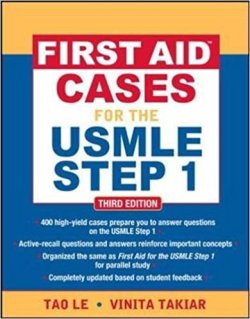
  7. First Aid Cases for the USMLE Step 1: Obviously everyone gets First Aid. Surprisingly few of my classmates, however, realized that there’s more to the series than First Aid alone. Though I didn’t find First Aid for the Basic Sciences: General Principles or [same]: Organ Systems to be that helpful, Cases is a real gem. It’s short, and features dozens of one-page cases in Q&A format that go through the common presentations you need to know, sorted into chapters by organ block. The interactive, case-based format is more engaging than reading, and I found doing cases in it to be a good way to “take a break” from hardcore studying while still learning. It’s best used towards the end of reviewing each organ block so you will get the most out of each case (and have a reasonable success rate in answering the questions).

These seven books may raise a few eyebrows since they’re not as well-known. I found them extremely helpful, however, and I trust you will too. I’m surprised that the word about them hasn’t gotten around yet. Fortunately, you’re in a select crowd that knows what’s up.